1 year of brainmapping
It’s been a year – and our results adding brain mapping to existing protocols have been phenomenal. Now we understand how to work with a person showing signs of dyslexia, for example. We’re so pleased!

It’s been a year – and our results adding brain mapping to existing protocols have been phenomenal. Now we understand how to work with a person showing signs of dyslexia, for example. We’re so pleased!
Aloha – we are also proud to announce that 4 channel training is now available at Windward Biofeedback Associates. 4 channel training means that 4 times the amount of training can be provided within the clinical hour. Now, this is not for everyone! A client needs to build up capacity to train, otherwise sleep is the order of the following hours. However when a client is ready for it, the results are amazing!
We are proud to announce that Brain Mapping using Brain Master Mini Q, read through New Mind Brain Mapping is now available at Windward Biofeedback Associates. Brain mapping allows more accurate training, and the New Mind Brain Mapping access portal permits clients and parents to rate symptoms regularly on a personalized symptom tracking site. This means our training is more precise, and feedback is more targeted.
 We’re so excited! Our brain mapping equipment has arrived, and very soon we will be able to match a map of your brain to the symptoms you mention to make our training even more effective! Imagine – you’ll be able to see what parts of your brain manage various tasks in a real time situation. Cool!
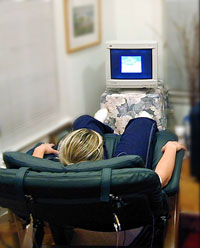 Aloha – the American Pediatric Association has announced that Neurofeedback is an “Evidenced Based Best Practice” to help remediate ADHD symptoms.
“The American Academy of Pediatrics (AAP) “Evidence-
Based Child and Adolescent Psychosocial Interventions”
tool is created twice each year and posted on the
AAP Web site at www.aap.org/mentalhealth, using
data from the PracticeWise Evidence-Based Services
Database, available at www.practicewise.com.”
We’re so proud that this evidence based grid was in fact based on the Hawaii State Child and Adolescent Mental Health Best Practice Grid posted in 2004. We remain first in the nation on child’s health.
This article comes thanks to LA Times Blog
June 17, 2010 | 7:00 am
If you’ve ever sat down at the piano to play a Mozart sonata and couldn’t find middle C, you know the feeling of performance anxiety. The condition, often called stage fright, is anxiety that is so severe it can impede performance. As many as three-quarters of musicians have musical performance anxiety. Thus, for serious students, learning to master this condition may be as important as learning all the scales.
A new study shows that a specific biofeedback technique is highly effective in decreasing stage fright. Researchers studied 14 college-age musicians. The musicians’ tendency to have stage fright was estimated in a performance before an audience at the start of the study (with questionnaires and heart rate measurements). Half of the musicians repeated the performance four weeks later. The other half received training in biofeedback that was designed to teach them how to control their heart rate through thoughts and emotions. These students also performed again after four weeks.
The study showed a 71% decrease in performance anxiety in the biofeedback group compared with the control group. The biofeedback group had a 62% improvement in performance. The musicians in the biofeedback group also said they had an overall increased sense of calmness, slept better, were more relaxed and had less anger in their everyday lives.
Biofeedback helps coordinate the brain-heart-body processes, the authors wrote. This synchronicity defeats performance anxiety and gives musicians a feeling of “flow,” the authors said, which they defined as “when a person is functioning at peak capacity, including mind, body and energy.”
The study appears in the current [June 2010] issue of Biofeedback, published by the Assn. for Applied Psychophysiology and Biofeedback.
Staff at Windward Biofeedback are interested in helping people maximize brain functioning in order to live more joyfully– neurofeedback training is useful for waking up lazy, bored brains, like ADHD kids have, for quieting down fast, obsessive brains, like many executives have, and for helping people sleep better when they haven’t been able to for awhile. Neurofeedback is a no medication – learn to control your own processes approach to functioning better. And yes, when it would help, our staff can provide psychotherapy, hypnosis, parent counseling, and marriage counseling, too.
And you get to play with all my gadgets as well – Breath training programs, Heart Math Biofeedback, alpha stimulation for pain management, Audio visual Entrainment Devices.
Sovereign Health, the largest nationally recognized behavioral health inpatient program in the country, with hospitals in nearly every state, has added neurofeedback to its evidence-based treatment program. They cite studies in the American Journal of Drug and Alcohol Abuse showing that neurofeedback increases success rates in treating addictions, eating disorders, and other mental health problems because neurofeedback addresses the underlying issues of anxiety, stress, and Post Traumatic Stress Disorder.